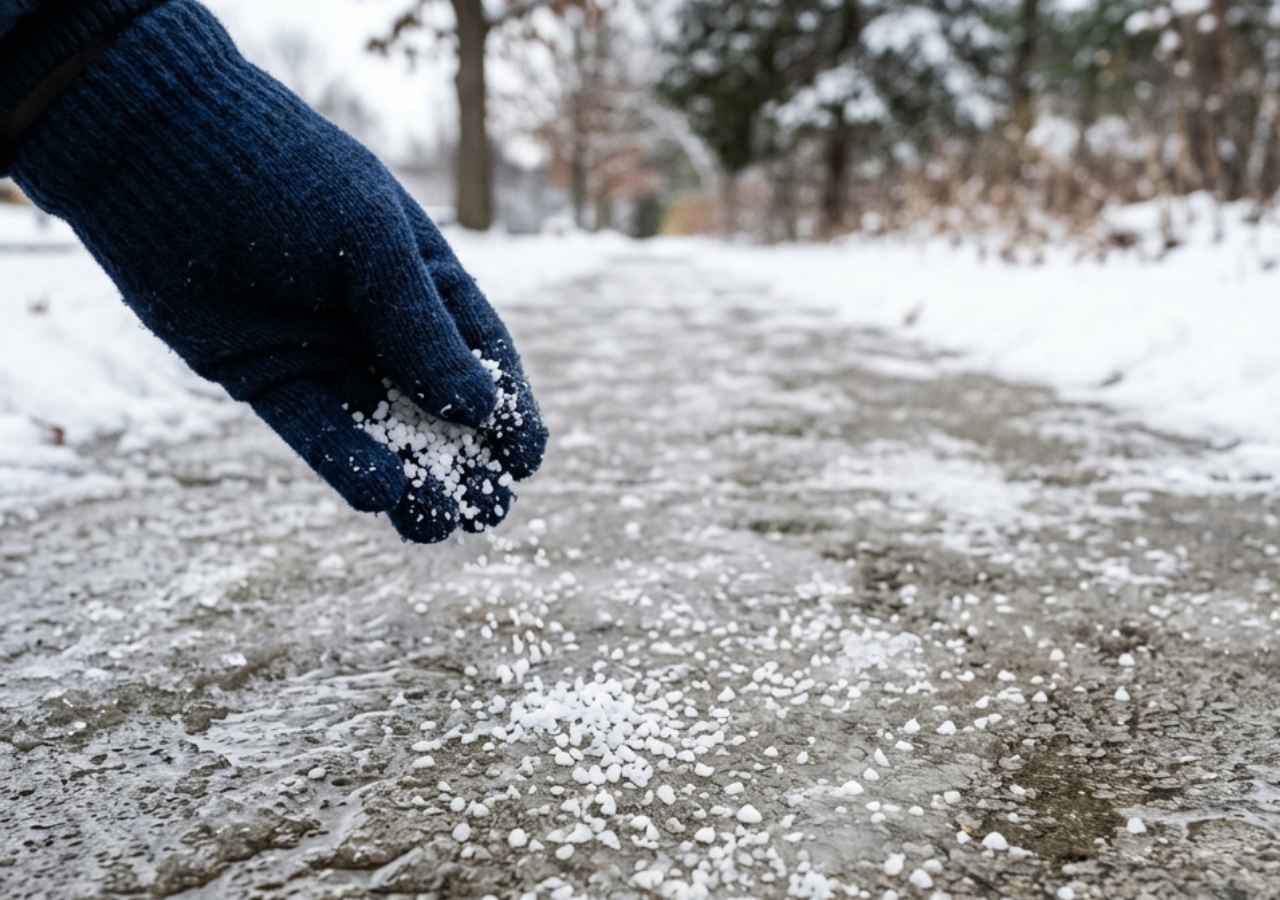
Will Table Salt Melt Sidewalk Ice Without Harming Concrete?
Yes, table salt can melt ice on a sidewalk. It contains sodium chloride, the same main ingredient found in traditional rock salt. The problem is that it is not harmless to concrete.
Using a small amount once in a while is unlikely to ruin a sound concrete sidewalk overnight. Repeated or heavy use is different. Salt can increase the risk of surface scaling and freeze-thaw damage. It can also introduce chlorides into the concrete. Concrete that is already cracked or reinforced with steel is more vulnerable to salt-related damage. Federal Highway Administration research has documented the role deicing salts can play in concrete deterioration.
For a property owner trying to clear one icy walkway, table salt may work in a pinch. It should not become the default solution for every winter storm.
Why Does Table Salt Melt Sidewalk Ice?
Salt changes the freezing point of water.
Once sodium chloride comes into contact with a thin layer of liquid water on the ice, it forms a salty solution known as brine. That solution freezes at a lower temperature than plain water. As a result, some of the ice begins to melt.
This is the same basic process used by sodium chloride deicers on roads and sidewalks. Sodium chloride remains one of the most widely used winter deicing materials in the United States.
Table salt may seem different because the crystals are smaller than typical rock salt. Chemically, however, both rely mainly on sodium chloride.
The smaller grains can dissolve quickly on thin ice. That does not make table salt a better choice for a large sidewalk. You would need a significant amount, and ordinary cooking salt is usually an expensive way to treat a large outdoor surface.
Can Table Salt Damage a Concrete Sidewalk?
It can contribute to damage, especially when it is used frequently.
The bigger issue is not simply that salt touches concrete. Winter conditions create a combination of salt, moisture, freezing and thawing.
Concrete contains tiny pores. Water can enter those pores. When temperatures fall, that water can freeze and expand. Repeated freezing and thawing place stress on the concrete.
Deicing salts can make this process more severe. One common result is scaling, where the top surface begins to flake or break away. FHWA research identifies deicing chemicals and freeze-thaw exposure as important causes of concrete surface scaling.
Salt exposure can also affect concrete through other mechanisms. Research published through the American Concrete Institute has examined chemical reactions between chloride-based deicers and components within hardened concrete.
This does not mean one light application will suddenly destroy a sidewalk. Concrete deterioration normally develops through repeated exposure and depends heavily on the condition and quality of the concrete.
Some Sidewalks Are More Vulnerable Than Others
Two concrete sidewalks exposed to the same amount of salt may not respond the same way.
A dense and properly constructed sidewalk that has been performing well for years can be much more resistant than concrete that already has problems.
Extra care makes sense when the sidewalk has:
- surface scaling or flaking
- existing cracks
- poorly finished concrete
- areas that regularly hold water
- previous freeze-thaw damage
- exposed aggregate or deteriorated edges
Concrete quality also matters. Proper air entrainment and good construction practices improve resistance to freeze-thaw conditions. FHWA research shows that poor curing, high absorptivity and inadequate freeze-thaw resistance can make concrete more vulnerable when deicing salts are present.
If the sidewalk is already deteriorating, adding large amounts of salt every time it freezes may speed up a problem that has already started.
Salt Can Also Affect Reinforcing Steel
This concern is more important for reinforced concrete.
Chloride ions can move through concrete over time. If enough chloride reaches embedded steel, it can contribute to corrosion.
Rust takes up more space than the original steel. That expansion can place pressure on the surrounding concrete and eventually contribute to cracking or spalling.
This process is especially well documented in reinforced concrete exposed to road salts. The FHWA identifies chloride exposure from winter deicing salts as a major factor in the deterioration of reinforced concrete transportation structures.
Not every residential sidewalk contains reinforcing steel. Still, the point is important when dealing with reinforced slabs, steps, ramps or other concrete around a property.
What Is the Better Way to Deal With an Icy Sidewalk?
Start with physical snow and ice removal rather than relying on salt to do all the work.
Shovel snow as soon as practical. Removing the bulk of the snow first reduces the amount of deicer needed afterward. University extension guidance recommends combining mechanical removal with limited deicer use rather than depending heavily on chemicals.
If a thin layer of ice remains, use only enough deicer to help break its bond with the concrete. Once the ice loosens, remove it rather than continuing to pour more salt over the surface.
This approach serves two purposes. It reduces salt exposure and gets the walking surface clear faster.
More salt does not automatically mean better results.
What About Sand Instead of Salt?
Sand works differently.
It does not melt ice. It gives shoes and tires more traction on a slippery surface.
That makes sand or another suitable abrasive useful when temperatures are too low for a deicer to work efficiently or when you want to minimize chemical exposure.
Transportation agencies also use abrasives when conditions reduce the effectiveness of chemical treatments.
There is a tradeoff. Sand remains on the sidewalk after the ice disappears, so it needs to be swept up. It can also enter drains and surrounding areas.
Still, if the immediate concern is getting safer footing without adding more chloride to the concrete, traction material can be useful.
Is Calcium Chloride Safer for Concrete?
Not necessarily.
Calcium chloride can work better than sodium chloride in colder conditions. However, it is still a chloride-based deicer.
That means changing from table salt to another chloride product does not eliminate concerns about concrete exposure. Research on deicing chemicals has found that sodium chloride, calcium chloride and other chloride-based products can all contribute to forms of concrete deterioration under the right conditions.
When choosing a commercial ice melt, check the product instructions and confirm that it is intended for the surface you plan to treat.
Claims such as “concrete safe” should also be read carefully. They do not mean that unlimited use carries zero risk.
Use Less Salt, Not More
One of the easiest ways to protect a sidewalk is simply to stop treating salt as the first step.
A practical winter routine looks like this:
- Clear the snow early. Packed snow is harder to remove once people have walked over it.
- Scrape away loose ice. Do as much mechanically as conditions allow.
- Apply deicer only where needed. Focus on remaining slippery areas rather than covering every inch of concrete.
- Give it time to work. Adding another heavy layer immediately usually wastes material.
- Remove loosened ice. Do not leave melting ice and salt sitting on the sidewalk longer than necessary.
- Sweep away leftover material when conditions permit. This also limits salt reaching lawns and nearby landscaping.
Excessive deicer use has consequences beyond concrete. Salt runoff can damage vegetation and enter groundwater and surface water. The University of Minnesota specifically recommends using deicers only where they are needed.
What If the Sidewalk Is Already Flaking or Cracking?
Winter salt may not be the original cause.
Sidewalk damage can develop from settlement, poor drainage, freeze-thaw cycles, construction defects, tree roots and normal aging. Salt can add another source of stress to concrete that is already vulnerable.
Look closely at the surface after winter.
Small areas of scaling may appear as thin flakes coming away from the top. More serious deterioration can leave rough patches, loose concrete or deeper surface loss.
Cracks also deserve attention when they begin widening, changing the level between slabs or creating a walking hazard.
If the sidewalk is already deteriorating, changing the type of deicer will not address the actual concrete damage. The concrete itself should be evaluated to determine whether it needs repair or replacement.
So, Should You Use Table Salt on an Icy Sidewalk?
Only as a limited solution.
Table salt will melt sidewalk ice because it contains sodium chloride. If there is a small icy patch and nothing else is available, a modest amount can help.
But there is no good reason to routinely pour cooking salt over the entire sidewalk.
Repeated salt exposure can increase the risk of concrete scaling and other deterioration. The risk becomes more important when the concrete is already damaged or regularly exposed to freezing and moisture.
For routine winter care, the better approach is straightforward: remove snow first, mechanically clear as much ice as possible and use deicer only where it is actually needed.
That keeps the sidewalk safer without exposing the concrete to more salt than necessary.