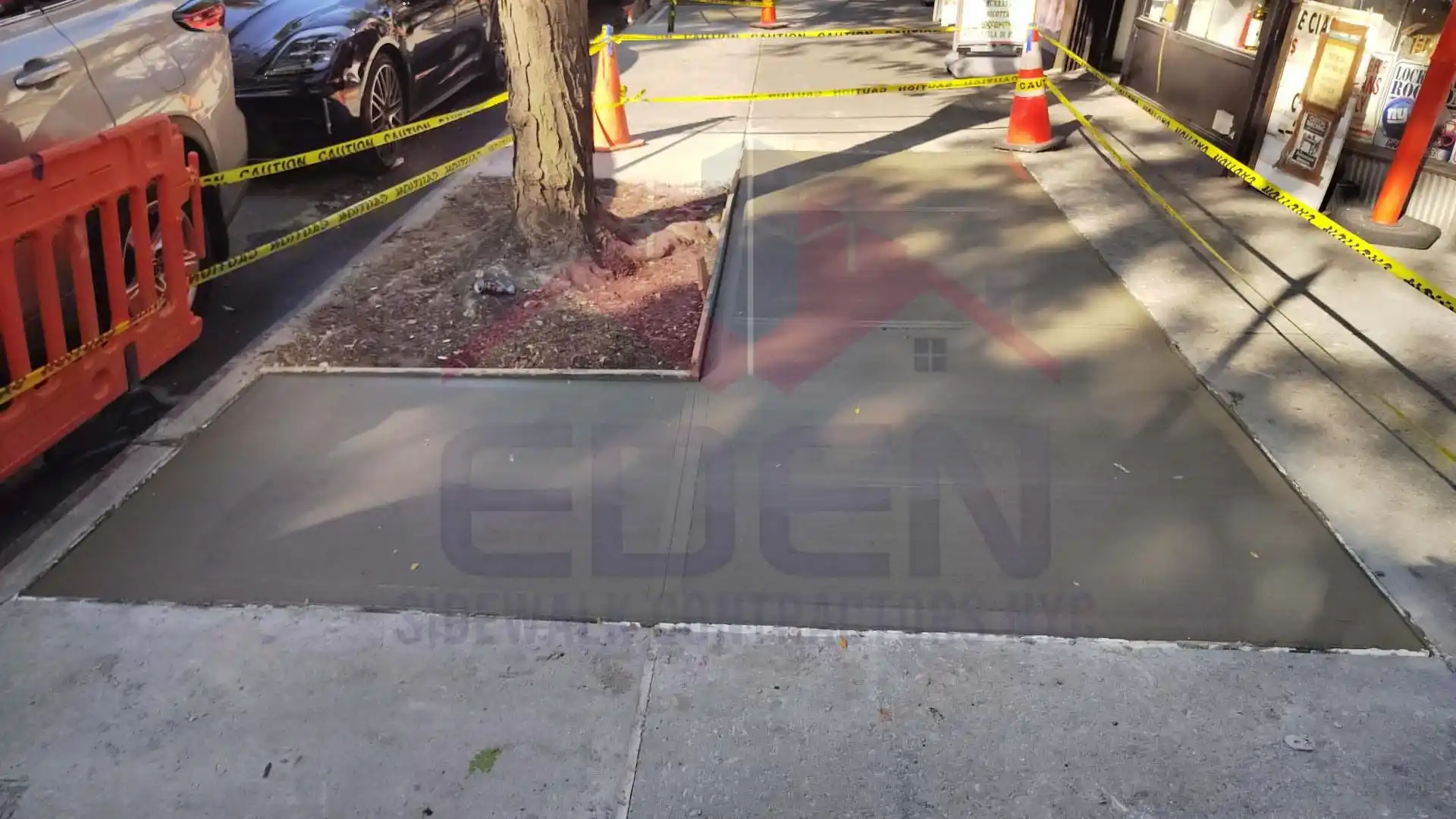
Who is Responsible for Sidewalk Repairs in NYC?
If you own property in New York City, here is something that surprises almost everyone: the city may technically own the sidewalk in front of your building, but you are the one responsible for maintaining it. That is not a technicality. You can argue your way out of, it is the law, and ignoring it can cost you far more than a simple repair.
However, there is an exception for certain residential properties. Specifically, the city might be responsible for maintaining the sidewalks adjacent to owner-occupied one-, two-, or three-family residential properties that are used exclusively for residential purposes. If you're dealing with such issues, understanding your obligations around Sidewalk repair in New York City can help you stay compliant and avoid liability.
The Legal Foundation: NYC Administrative Code § 7-210
The rule is spelled out in
New York City Administrative Code Section 7-210, which places the obligation to install, repair, replace, and maintain sidewalks squarely on the property owner abutting that sidewalk. This applies regardless of whether the damage was caused by weather, foot traffic, or the natural aging of concrete.
Section 19-152 of the Administrative Code reinforces this further, specifying that property owners are responsible for sidewalks adjoining their properties. These are not vague guidelines, they are enforceable city statutes that have been tested and upheld in New York courts.
What this means practically: if someone trips and falls on a broken slab in front of your building, you, not the city, are the liable party. Courts have repeatedly held that this duty is non-delegable, meaning even if you have assigned sidewalk maintenance to a tenant or property management company, you remain legally accountable.
The Important Exception: 1–3 Family Homes
There is one significant carve-out to this rule. If you own a one-, two-, or three-family residential property that is owner-occupied and used exclusively for residential purposes, the city, not you, bears responsibility for sidewalk maintenance and liability.
In practice, this means:
- If you live in your one-family home in Staten Island and a pedestrian trips on a cracked flag out front, the city is the liable party, not you.
- If you own a two-family home in Queens and rent out both units (without living there yourself), the exception does not apply, you are responsible.
- The moment the property has four or more units, or is used for commercial purposes, full property-owner responsibility kicks in regardless of occupancy.
This distinction matters enormously for insurance and legal purposes. If you own a qualifying 1–3 family home, report any defective sidewalk directly to the city by calling 311 or submitting a complaint at NYC.gov, and do it promptly.
Who Enforces Sidewalk Standards in NYC?
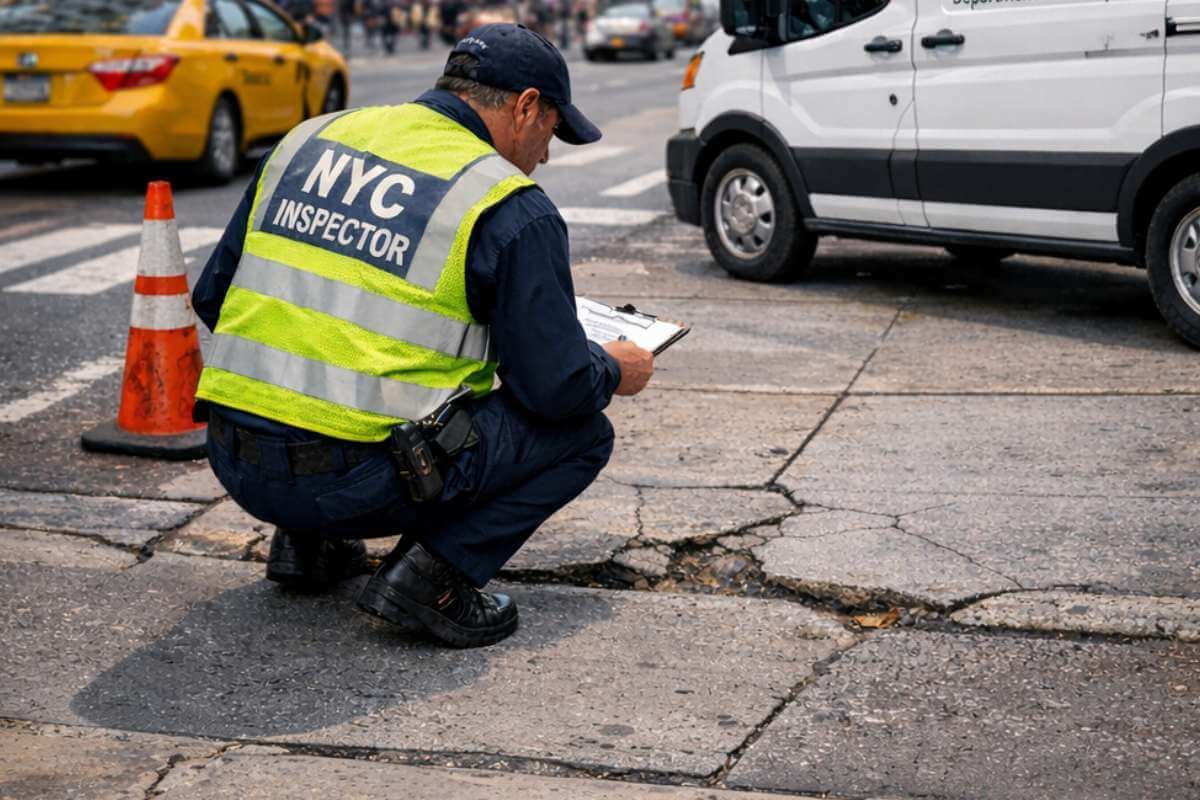
The Department of Transportation (DOT) is the primary enforcement body. DOT inspectors conduct regular sidewalk inspections across the five boroughs and have the authority to issue a Notice of Sidewalk Violation for unsafe conditions.
Once you receive a violation notice, a copy is filed with the county clerk and remains on record until the repairs are completed. This matters beyond just the repair itself, an open violation can complicate the sale of your property, delay refinancing, and in some cases trigger policy non-renewal from your building insurer. If the repairs are not made within the required window, the city can hire its own contractor, complete the work, and bill you directly. City-contracted repair is almost always more expensive than hiring your own licensed contractor.
Some conditions the DOT specifically flags as hazardous include:
- Vertical displacement of sidewalk flags by half an inch or more
- Horizontal cracks or separations wide enough to loosen or remove concrete pieces
- Asphalt patchwork that does not meet DOT standards
- Elevation changes caused by tree roots protruding more than half an inch
- Settled slabs that collect standing water and create slippery surfaces
After receiving a Notice of Violation, property owners generally have 75 days to make repairs before the city steps in. The notice itself carries no fine, but the city’s intervention and billing come at a significant premium.
The Tree Root Problem and When the City Pays
Tree-lined streets are one of New York City’s best qualities. They are also a major driver of sidewalk damage. As street trees age, their root systems expand and push up against, and through,concrete slabs.
Here is where it gets nuanced. Although the Parks Department plants and maintains city trees, the property owner is still responsible for the sidewalk damage those roots cause, at least initially. This feels deeply unfair to many owners, and for good reason, you did not plant the tree, you do not prune it, and you have no control over its root growth.
The relief available to you depends on your property type:
If you own a 1–3 family home
The NYC Parks Department’s Trees & Sidewalks Program may cover the cost of repairing tree-root damage at no expense to you. The program is specifically for owner-occupied residential properties. Once repairs are completed, both the tree and the work are inspected. If you paid out of pocket first, you can file a reimbursement claim with the City Comptroller’s office within 90 days of completing the work. Keeping your receipts, permits, and inspection documentation is essential for this process.
If you own commercial property or a larger residential building
The Trees & Sidewalks Program does not apply. You will need to absorb the cost and, in some cases, coordinate with the Parks Department before trimming or removing roots which can add time and expense to an already disruptive repair.
Curbs: A Commonly Misunderstood Responsibility
Curbs are not your responsibility. Curbs are part of NYC’s street infrastructure, and the DOT is responsible for repairing or replacing them at no cost to you.
If you notice a damaged, missing, or sunken curb adjacent to your property, report it to the city via 311. The DOT will inspect and address it. If you are already undertaking a sidewalk repair, the DOT encourages (but does not require) you to flag any curb issues at the same time to avoid reopening the work area later.
What Happens If You Ignore a Violation?
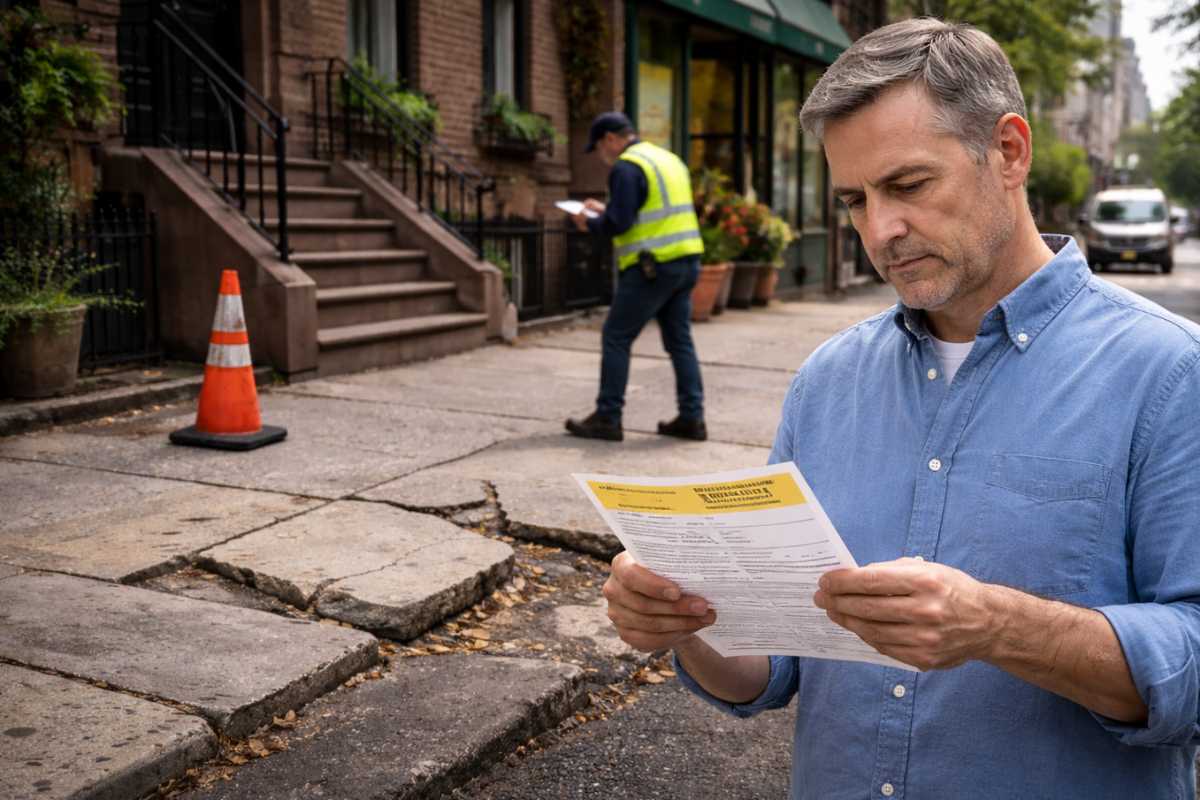
Ignoring a DOT sidewalk violation is not a viable strategy. The practical consequences escalate in stages:
First, the violation sits on your property record with the county clerk, visible to any title search. This can slow or kill a real estate transaction.
Second, if 75 days pass without evidence of repair, the city can send its own crew and bill you. Municipal contractors charge rates that are consistently higher than what you would pay by hiring a licensed private contractor.
Third, some insurers, particularly in the New York City market, have adopted a zero-tolerance policy for open sidewalk violations. If an inspection during your policy renewal period reveals unsafe conditions, you could face non-renewal, which creates serious coverage gaps for a building owner.
Fourth, if someone is injured on your unrepaired sidewalk during this period, the liability exposure is significant. Under Section 7-210, injured pedestrians can pursue the property owner directly. New York courts have awarded substantial damages in sidewalk trip-and-fall cases, and insurance underwriters report that sidewalk-related injuries now surpass fire and water loss as the leading liability claim against NYC landlords.
How Much Does Sidewalk Repair Cost in NYC?
Costs vary based on the size of the job, site conditions, and the contractor you hire. As a general benchmark based on current market rates:
- Standard repairs: roughly $5 to $15 per square foot
- Small jobs (replacing a few flags, around 50 sq ft): approximately $700 to $1,200
- Larger or complex jobs involving tree roots, ADA compliance, or tight urban access: $3,000 to $7,000 and up
- Permit fee: approximately $70 for up to 300 linear feet (required for any permitted sidewalk work)
Winter repairs typically cost more due to curing requirements and weather protection. Scheduling work in spring or fall, when contractors have more availability, can sometimes reduce costs.
Always verify that your contractor holds a valid Home Improvement Contractor License from the NYC Department of Consumer and Worker Protection, and confirm they will handle the permit process and final DOT inspection. An unpermitted repair is not a compliant repair, and it will not clear an open violation.
Who Is Liable When Someone Gets Hurt?
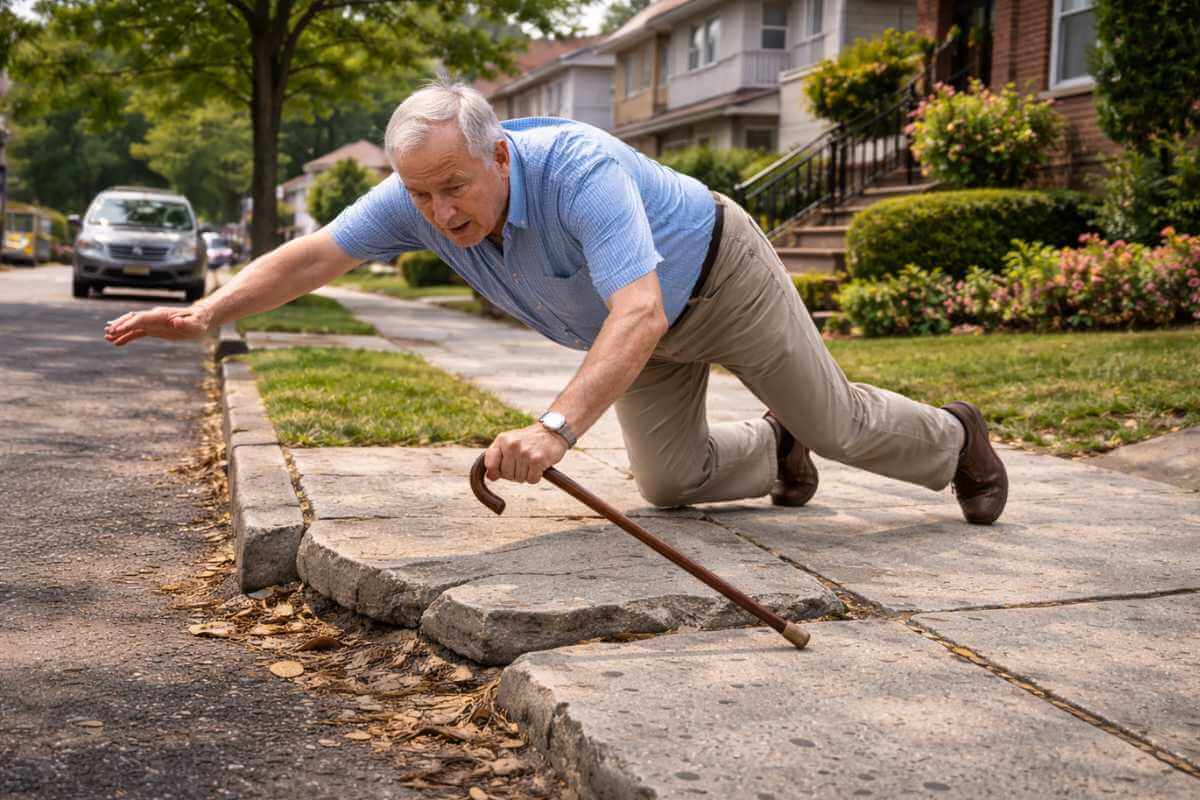
Sidewalk trip-and-fall claims in New York City follow a clear framework based on where the injury occurred:
|
Location / Condition |
Responsible Party |
|
Adjacent to commercial property or 4+ unit building |
Property owner |
|
Adjacent to owner-occupied 1–3 family residential property |
City of New York |
|
Adjacent to city-owned building or land |
City of New York |
|
Damage caused by tree roots at 1–3 family home |
City (via Parks Program) |
|
Damage caused by a contractor's work |
The contractor |
The city can be held liable if it had prior written notice of a defect and failed to repair it within 15 days. If you need to pursue a claim against the city, a Notice of Claim must be filed within 90 days of the injury, and any lawsuit must be brought within one year and 90 days.
Frequently Asked Questions
Can the city make me pay for sidewalk repairs I didn’t cause?
Yes. Under NYC law, property owners are responsible for maintaining the sidewalk adjacent to their property regardless of the cause of damage including ordinary weather and aging. The only meaningful exception is tree-root damage to qualifying residential properties through the Trees & Sidewalks Program.
How do I know if I have a sidewalk violation?
DOT will send a notice to the property owner of record. You can also check your property’s violation status through the NYC DOT’s online portal. An open violation will appear on any title search of your property.
What if I can’t afford the repairs right now?
The DOT offers an Expedited Sidewalk Repair Program in some situations, allowing the city to perform the repairs on your behalf in exchange for payment. This may be an option for qualifying residential properties, though city-performed work generally costs more than using a private contractor.
Does a sidewalk violation affect my property taxes or mortgage?
A violation itself does not directly affect taxes, but unpaid repair costs billed by the city can result in a lien against the property, which complicates refinancing and sales.
How long do I have to fix a sidewalk violation?
Generally, 75 days from receipt of the Notice of Violation before the city can intervene with its own crew.
Who is responsible for sidewalk repair in NYC if I just bought the property?
Responsibility transfers with ownership. If you purchased a property with an open sidewalk violation, you are now responsible for resolving it. Always conduct a sidewalk inspection and title search before closing on a New York City property.
The Bottom Line
NYC sidewalk responsibility is one of those areas where the law is clear but the details matter enormously. As a property owner, your best protection is staying ahead of damage, scheduling periodic inspections, addressing cracks early when repairs are cheaper, and knowing when the city’s programs can work in your favor.
If you’ve received a DOT Notice of Violation or you’ve spotted damage that could put you at risk, the time to act is now, not after a claim is filed or a sale falls through. Eden Sidewalk Repair specializes in NYC-compliant sidewalk repair NYC services across all five boroughs, handling permits, DOT inspections, and violation removal from start to finish.